
Most companies can tell you how much electricity their offices use. Fewer can tell you the carbon cost of every product they buy, ship, or sell. That gap is the Scope 3 problem – and in 2026, it is no longer a problem companies can defer.
Across Asia, regulators are moving fast. China’s Shanghai and Shenzhen exchanges require major listed companies to publish their first mandatory sustainability reports by 30 April 2026. Singapore and Hong Kong are enforcing International Sustainability Standards Board (ISSB)-aligned climate disclosures for large listed companies. In Europe, the Corporate Sustainability Reporting Directive (CSRD) mandates full Scope 3 disclosure. The message from every direction is the same: value chain emissions must now be measured, reported, and managed.
This article explains what Scope 3 is, why it matters, and what your organisation should be doing about it right now.
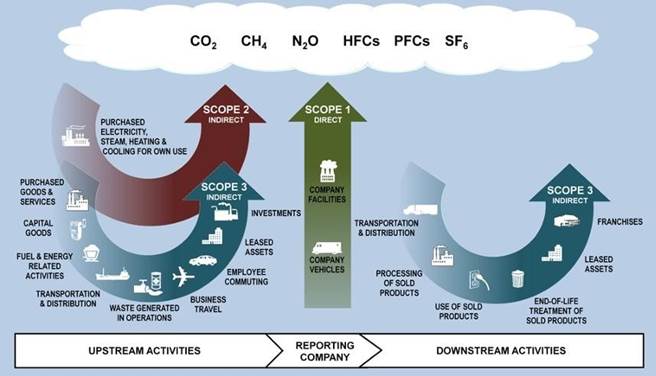
Greenhouse gas (GHG) emissions are divided into three categories under the GHG Protocol, the globally accepted standard for corporate carbon accounting:
Scope 1 covers direct emissions from sources your company owns or controls: your factories, furnaces, and company-owned vehicles.
Scope 2 covers indirect emissions from the electricity, heat, or steam you purchase. Every time you turn on the lights, there is a carbon cost.
Scope 3 is everything else: the emissions that happen across your entire value chain, both upstream (suppliers) and downstream (customers and end-of-life). This is where the real numbers are.
According to research by the Carbon Trust, Scope 3 emissions typically account for 65 – 95% of a company’s total carbon footprint, yet they remain the least measured of the three scopes.
Source: KEY ESG — https://www.keyesg.com/article/understanding-scopes-1-2-and-3
What Does Scope 3 Actually Cover?
The GHG Protocol’s Corporate Value Chain (Scope 3) Standard – the only internationally accepted methodology for value chain emissions divides Scope 3 into 15 categories spanning upstream and downstream activities.
Upstream categories include emissions from purchased goods and services, capital goods your company buys, the energy used in your fuel supply chain, transportation and distribution of inputs, waste generated in your operations, business travel, and employee commuting.
Downstream categories include the transportation of your finished products to customers, how customers use the products you sell, and what happens to those products at the end of their life including recycling, landfill, or incineration. It also includes emissions from leased assets, franchises, and investment portfolios.
For most manufacturers, the biggest Scope 3 category is purchased goods and services: the embedded carbon in the raw materials and components they buy. For banks and asset managers, it is investments. For airlines, it is the use of sold products (i.e., passengers burning fuel). Knowing which categories matter most for your sector is the essential first step.
Why Is Scope 3 So Hard to Measure?
The short answer: You don’t control your suppliers’ operations. Unlike Scope 1 and 2, where you are measuring your own energy bills and fuel receipts, Scope 3 requires data from dozens, hundreds, or thousands of external parties many of whom do not track their own emissions.
This means companies often rely on secondary data: industry-average emission factors published by databases such as the GHG Protocol, Ecoinvent, or government agencies. These are estimates, not measurements, and they vary. The quality of your Scope 3 inventory is only as good as the data you can gather from your supply chain.
The CSRD’s Scope 3 Reporting Requirements (2026 Update) from Anthesis Group provide a useful breakdown of how the European Standard on climate reporting (ESRS E1) expects companies to disclose their material Scope 3 categories, set reduction targets, and link these to their broader climate transition plans. The principle of double materiality (assessing both how climate risks affect your business and how your business affects the climate) is central to this framework.
Practically speaking, this means building supplier engagement programmes, sending questionnaires, requesting third-party verified emissions data, and progressively moving from industry averages toward company-specific figures.
The regulatory picture is converging, even if timelines differ:
China: The China Securities Regulatory Commission (CSRC) has launched its disclosure pilot targeting A-share listed companies, with fiscal year 2025 sustainability reports due by 30 April 2026. Scope 3 disclosures are expected to grow in line with ISSB (International Sustainability Standards Board) alignment.
Singapore & Hong Kong: Both markets are enforcing ISSB S2-aligned climate disclosures for major listed companies from 2026. Scope 3 is explicitly within scope for large issuers. More detail is available via the APAC ESG Regulations Guide on ESGpedia.
Australia: Mandatory climate risk disclosures are now in force for large Australian entities, with Scope 3 increasingly expected as reporting matures.
Latin America: Brazil is advancing sector-specific guidance ahead of COP30 (United Nations Climate Change Conference) later in 2026. Scope 3 disclosures are becoming a condition of sustainable bond issuance.
Europe (CSRD): Full Scope 3 disclosure across all material categories is mandatory. Companies must also set reduction targets and demonstrate how value chain emissions connect to their transition plans. Guidance is available from PwC on measuring Scope 3 emissions.
The scale of Scope 3 can feel overwhelming. It doesn’t need to be.
Here is a practical progression:
Step 1: Screen for Materiality.
Not all 15 categories will be significant for your business. Start by identifying which ones are likely to be large relative to your total footprint. The GHG Protocol’s Technical Guidance for Calculating Scope 3 Emissions provides a practical framework for this assessment.
Step 2: Collect Data, Even Imperfect Data.
Use industry-average emission factors to get a baseline. This gives you a directional view of where your biggest impacts lie. Document your methodology clearly.
Step 3: Engage Your Suppliers.
Work with your most significant suppliers to obtain company-specific data. This is where the heavy lifting happens, but it is also where the most credible reductions can be driven.
Step 4: Set Targets and Report.
Use your inventory to set science-based reduction targets. Report under the framework required in your jurisdiction – CSRD, ISSB S2, or national equivalents.
Step 5: Use Technology.
Platforms such as Persefoni, Coolset, IBM Envizi, and Greenly are purposebuilt for Scope 3 data collection and reporting. Many are now aligned with CSRD requirements. A useful comparison of tools is available at Coolset’s Scope 3 Reporting Software Guide.
Scope 3 is not just a compliance exercise. It is a strategic opportunity. Companies that understand their value chain emissions can make smarter procurement decisions, build more resilient supply chains, have more credible conversations with investors, and position themselves ahead of regulatory tightening.
Investors globally are demanding greater Scope 3 transparency. Sustainable finance frameworks are increasingly linking access to green capital to the quality of a company’s emissions inventory. And regulators have made clear: the era of voluntary, self-defined sustainability claims is over.
The companies that invest in Scope 3 readiness today will not just be compliant. They will be competitive.
If you continue browsing this website, you agree to our policies:
|
ESG Business Institute offers this website, including all information, tools and services available from this site to you, the user, conditioned upon your acceptance of all terms, conditions, policies and notices stated here.
By visiting our site, you engage in our "Service" and agree to be bound by the following terms and conditions ("Terms of Service", "Terms"), including those additional terms and conditions and policies referenced herein and/or available by hyperlink. These Terms of Service apply to all users of the site, including without limitation users who are browsers, vendors, customers, merchants, and/or contributors of content.
Any new features or tools which are added shall also be subject to the Terms of Service. You can review the most current version of the Terms of Service at any time on this page. We reserve the right to update, change or replace any part of these Terms of Service by posting updates and/or changes to our website. It is your responsibility to check this page periodically for changes. Your continued use of or access to the website following the posting of any changes constitutes acceptance of those changes.
While we have a stringent process in our research to ensure quality selection of credible resources to benefit our users, we are not responsible if information made available on this site has caused liability in any form to you and your organisation. The material on this site is provided for general information only and should not be relied upon or used as the sole basis for making decisions without consulting primary, more accurate, more complete or more timely resources. Any reliance on the material on this site is at your own risk.
This site may contain certain historical information. Historical information, necessarily, is not current and is provided for your reference only. We reserve the right to modify the contents of this site at any time, but we have no obligation to update any information on our site.
Third-party links on this site may direct you to third-party websites that are not affiliated with us. We are not responsible for examining or evaluating the content or accuracy and we do not warrant and will not have any liability or responsibility for any third-party materials or websites, or for any other materials, products, or services of third parties.
We are not liable for any harm or damages related to the use of services, resources, content, or any other transactions made in connection with any third-party websites. Complaints, claims, concerns, or questions regarding third-party resources should be directed to the third party.
We may, but have no obligation to, monitor, edit or remove content that we determine in our sole discretion are unlawful, offensive, threatening, libellous, defamatory, pornographic, obscene or otherwise objectionable or violates any party's intellectual property or these Terms of Service.
You agree that your comments will not violate any right of any third party, including copyright, trademark, privacy, personality or other personal or proprietary right. You further agree that your comments will not contain libellous or otherwise unlawful, abusive and/or obscene material.
You may not use a false e-mail address, pretend to be someone other than yourself, or otherwise mislead us or third parties as to the origin of any comments. You are solely responsible for any comments you make and their accuracy. We take no responsibility and assume no liability for any comments posted by you or any third party.
Your submission of personal information is governed by the ESG Business Institute Privacy Policy.
ESG Business Institute welcomes comments, questions, concerns, or suggestions about the Terms of Service. You can contact us or get support at admin@esg-bi.org.
This privacy policy has been compiled to better serve those who are concerned with how their personal information is being used online. Personal information is information, whether true or not, about an individual who can be identified either from that information or from that information and other information to which the organisation has or is likely to have access. It does not include information where your identity has been removed, which is known as anonymous data.
Please read our privacy policy carefully to get a clear understanding of how we collect, use, protect or otherwise handle your personal information.
When registering on our site, we may collect, use, store and transfer personal data about you. We have grouped these as follows:
We do not collect any Special Categories of Personal Data about you (this includes details about your race or ethnicity, religious or philosophical beliefs, sex life, sexual orientation, political opinions, trade union membership, information about your health and genetic and biometric data), nor do we collect any information about criminal convictions and offences.
We collect personal data as follows:
Direct Interactions. You may give us your Identity and Contact Information by filling out a form or entering information on our website. This includes personal data you provide when you do any of the following:
We may use the information we collect from you when you register, surf the website, or use certain site features in the following ways:
The legal basis for the processing of your personal information is that it is necessary for the performance of a contract with you, where it is necessary for our legitimate interests and your interests and fundamental rights do not override those interests, where we need to comply with a legal or regulatory obligation or where we obtain your consent to the processing of your personal information.
We will only use your personal information for the purposes for which we collected it unless we reasonably consider that we need to use it for another reason and that reason is compatible with the original purposes. If you wish to get an explanation as to how the processing for the new purpose is compatible with the original purpose, please contact us at admin@esg-bi.org.
If we need to use your personal information for an unrelated purpose, we will notify you and we will explain the legal basis which allows us to do so.
Your personal information is contained behind secured networks and is only accessible by a limited number of persons who have special access rights to such systems, and are required to keep the information confidential.
We will only hold your information for as long as is necessary for the purposes described in this Privacy Policy or our terms and conditions, or for legal or business purposes. When determining the relevant retention periods, we will take into account factors including:
While we are using cookies on our site, we do not use them for tracking purposes. You can choose to have your computer warn you each time a cookie is being sent, or you can choose to turn off all cookies. You do this through your browser settings. Since most browsers are a little different, look at your browser's Help Menu to learn the correct way to modify your cookies.
If you turn cookies off, some of the functions that make your site experience more efficient might not work and may result in certain features of the site not functioning properly.
When you use and access the Site, we may place a number of cookies files in your web browser.
ESG Business Institute uses or may use cookies and/or web beacons to help us determine and identify repeat visitors, the type of content and sites to which a user of our Site links, the length of time each user spends at any particular area of our Site, and the specific functionalities that users choose to use. To the extent that cookies data constitutes personally identifiable information, we process such data on the basis of your consent.
We use both session and persistent cookies on the Site and we use different types of cookies to run the Site:
We do not envisage that any decisions will be made about you using automated means. However, we will notify you if this position changes.
We do not sell, trade, or otherwise transfer to outside parties your personal information.
Occasionally, at our discretion, we may include or offer third-party products or services on our website. These third-party sites have separate and independent privacy policies. We, therefore, have no responsibility or liability for the content and activities of these linked sites.
Nonetheless, we seek to protect the integrity of our site and welcome any feedback about these sites.
Google's advertising requirements can be summed up by Google's Advertising Principles. They are put in place to provide a positive experience for users: https://support.google.com/adwordspolicy/answer/1316548?hl=en
We have not enabled Google AdSense on our site but we may do so in the future. If at any time you would like to unsubscribe from receiving future emails, you can email us at admin@esg-bi.org and we will promptly remove you from ALL correspondence.
We may change this Privacy Policy from time to time, to reflect changes at ESG Business Institute, or for legal or regulatory reasons. Unless we are unable to do so, we will give you reasonable notice of any changes to this Privacy Policy, which may be by notifying you via email and/or by posting an updated version on our website.
Please contact us at admin@esg-bi.org for the following reasons:
You have various rights in relation to your personal information, including your right to:
Updated: July 2021